You wouldn’t think it possible, really. That in this day and age the world’s largest jazz festival would commission a white theatre director to create SLĀV, a major dramatic work based on African American slave songs starring a white singer and featuring a predominantly white cast. And yet, as anyone following the cultural news knows, this is just what has happened in Montreal, where the sold-out show is a highly controversial hit. In response, there have been protests and letters to the editor and angry facebook posts and more.
You wouldn’t think it possible that such an artistically misguided and insensitive plan should have been brought to fruition on such a big stage and with so much institutional support. Unless of course, you were familiar with the history of the Montreal International Jazz Festival, as I am, in which case you would not be in the least bit surprised.
 Before I tell you more, let me briefly address those defenders of artistic freedom and equality who are outraged by the outrage, angered by the anger, and who insist that like Betty Bonifacci who stars in the show, they “do not see colour” and don’t see a problem with white folks mounting a show about what it was like to be a Black slave, within a white-owned jazz festival for white audiences. Why not, they ask?
It’s a fair question, to which I offer this fair answer: if racial discrimination against Black folks by white folks no longer existed, SLĀV might conceivably be viewed as a purely aesthetic work, (even though it has itself chosen to dramatically emphasize the socio-political context of the slave songs it features, so then again, maybe not.) But given that we live in a world where discrimination still exists, and in which the legacy of race-based injustices continues to generate inequalities today, and given too that the music being presented existed as a communal response to racial oppression, SLĀV simply cannot be removed from its social context. The music and its social history are one and the same. And that means that SLĀV’s creators must – at the very least – grapple with their relationship to that music and that history if they are going to engage with it.
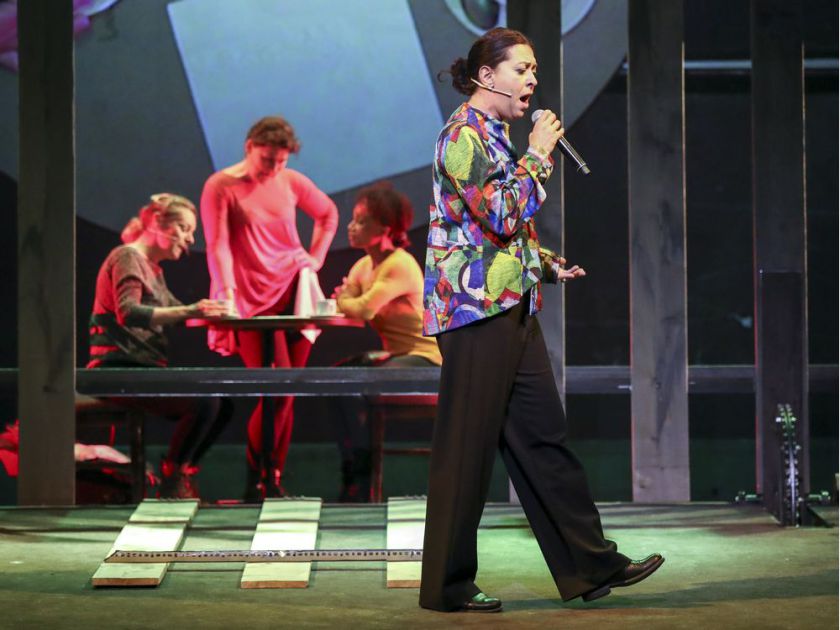
They don’t, of course. And that the jazzfest, SLĀV director Robert Lepage and star Bonifacci all resolutely refuse to question that relationship is precisely what allows them to feel privileged enough to heedlessly exploit it.
So, since they won’t question it, allow me to help out. After all I was kicking around when the jazz festival began in 1980, and even a little before, playing jazz in Montreal and hanging out in jazz clubs, immersing myself in the extraordinarily vibrant and rich and predominantly Black history of jazz in the city. Not that you would have ever learned anything about that history from the jazz festival, which has spent the past 40 years largely whitewashing it. Where you might ask, is the Museum of Montreal Jazz? Whoops, in their rush to sell t-shirts the biggest jazz festival in the world forgot to create one. How about the Montreal Jazz Hall of Fame? Sorry, slipped their minds. How about ANY meaningful celebration of the hundreds of jazz clubs and jazz musicians that thrived in one of the greatest jazz cities in the world for decades prior to the founding of the jazz festival by Alain Simard and Andre Menard in 1978? Well there was that one concert back in whenever, and I think we did a photo exhibition in a hotel lobby once, 28 or 29 years ago, and oh we did make a hero of Oliver Jones. But all the countless other great musicians who made and played jazz for over 50 years in Montreal, most of whom were Black? Yeah, not interested.
I remember when the jazz festival was just picking up steam in the early 80s, and was still being held on rue St-Denis. Those were the good days. There were no less than 5 established jazz clubs within 2 blocks of St-Denis and Ontario streets and they were even more crowded than usual during the jazz festival. Chez Dumas, Le Grand Cafe, Club 2080, Cafe Théleme and le Jazzbar weren’t part of the festival though, and neither were all the other bars and restaurants on the street packed to bursting. Which is pretty much why Menard and Simard soon decamped to Ste Catherine street, even now a concrete wasteland, but one that offered the great advantage of having nowhere for visitors to drink or eat. Thus through the judicious introduction of fencing, badges, and festival-run food and drink kiosks, the move greatly increased the flow of doubloons into the jazz festival coffers.
Of course, as a byproduct, rather than part-time jazz fans discovering all the cool clubs near St-Denis and returning now and again during the year, thus helping the sustainability of the jazz scene, the new all-in-one megafest soon sucked literally every cent of jazz bucks from the city during its fenced off 10 day run, leading to the rapid decline and disappearance of every one of those clubs, as well as others in other parts of town.
Not that all of the blame can be laid at the feet of the jazz festival, I admit. Jazz today has essentially died as a living art form, except for a few small pockets of hybridized creativity, because nearly all of the people who created it and lived it have passed away.
Yet of those, Montreal had so many! I spent endless nights back then at Le Jazzbar, a dive run by jazz guitarist Ivan Symonds. He didn’t play quite as well as his remarkable cousin Nelson Symonds, who was reportedly once asked by John Coltrane to join his band (the cousins had come to Montreal from Nova Scotia as young men in the 1950s and spent their lives playing jazz in the city) but he was still a terrific player deeply rooted in the tradition, and a generous man. He played 6 nights a week in his storefront nightclub til 3 am. As a teenage sax player, hearing his gruff “Did’ja bring ya horn?” when I walked in was pretty much my wildest dream come true. The bass player in his trio, Nick Aldrich, had played with Cab Calloway at the Cotton Club in the 1930s. The beautiful drummer Charlie Duncan played with a divine subtlety and an angelic smile. These were a few of the many, many African-Canadian musicians whose lives could be defined by two words Montreal and Jazz.
And yet, they and their peers have almost never been acknowledged by the world’s largest jazz festival that grew up around them. They didn’t get gigs when they were alive, and they got little or no respect when they passed. The jazz festival has basically ignored the vast history of jazz in their own city, and most of that history is Black.
For years I had a press pass to the festival, as a jazz critic for the Montreal Mirror and then the Montreal Gazette. I saw so many fantastic shows there, many featuring legends of jazz. It was an incredible opportunity and I would never deny that the festival has done many wonderful things to promote the music. But I would also say they have definitely done many things that have hurt the music, and the people who created it. And the commissioning and presenting of SLĀV stands in that proudly ignorant and irresponsible tradition.
I remember when my press pass was revoked, after I wrote an article critical of some of these whitewashing aspects of the jazzfest. They have thin skins over there, and they don’t like being treated as anything other than cultural celebrities and great humanitarians. But in my opinion the real humanitarians are the musicians who made the music, not the promoters who have gotten rich off of it. And this is perhaps why those promoters can’t see the obvious problem with SLĀV, which is that it lacks humanity.

Their defensive response to critiques of SLĀV demonstrates that after 40 years of presenting jazz the festival’s organizers still haven’t learned – have never been willing to learn – about the history, both in Montreal and in the USA, that shaped the music and the voices that played it.
And as I say, I’m not surprised. Saddened but not surprised. It’s hard to believe, but after all that time close to all that deep music, all that sorrowful history, and all those legendary musicians at their festival (many of whom were children in the 1920s and actually knew people who had been slaves!) they only ever saw the bright lights and the big bucks. Not the people. Not the places. Not the very Black past. To say that this reflects a relatively mild yet almost universal Quebecois racism is merely to state the obvious.
So in the end, when it comes to SLĀV, the question isn’t: how could they? But rather, given the festival’s history, what else would you expect?


 SOBOLTALK
Leave a comment