In my book, and on this blog, and practically anywhere else where I can find an audience lately, I have been saying that the only way to overcome the eco-cidal tendencies of OS2 (literate) culture is for us to build bridges between sustainable OS1 (oral) culture and hyper-efficient OS3 (digital) culture.
The two obvious questions are: Why and How?
The You Are Your Media book is mostly about the Why. But the How is ultimately more important. Yet it is also more elusive. It has taken me 25 years to figure out the Why and to be honest I am still struggling with the How. Nonetheless I will try to summarize what I do know about how we can bridge oral and digital cultures to save ourselves from ourselves.
The first step is to understand what we are doing wrong. It can be introduced this way:
- literate (OS2) tools are monological, thus they enable a monological culture that does not listen well, especially to the earth, resulting in our current eco-crisis
- both oral (OS1) and digital (OS3) tools are dialogical, thus they each enable dialogical cultures that do listen well
- yet only OS1 cultures, which have been rendered impotent by OS2, know how to listen to the earth, (OS2 not having ears and OS3 being disembodied)
Thus the most important and informed truths about our relationship with the earth are available only from members of OS1 cultures. So the first step in building bridges between sustainable OS1 culture and hyper-efficient OS3 culture is to grasp that on the far side of that bridge is a deeper earth-wisdom than either literate or digital culture is capable of. A wisdom that yields bridges like these, in Cherapunji, India. Ancient bridges not built but grown from the roots of great trees…
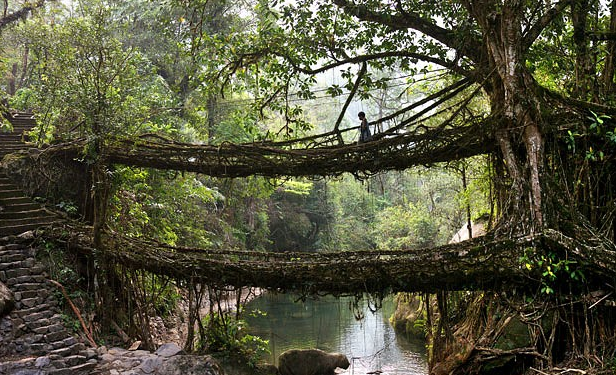
By way of comparison, how would OS2 have crossed that river? It would have chopped down the tree and built a nice sturdy wooden bridge. And eventually it would have clearcut the entire forest in pursuit of more monological solutions. That is what we are doing to our world.
But if instead we want sustainable bridges to a sustainable future, we will have to grow them. Specifically we have to grow relationships between OS1 and OS3 cultures. Which will be easier than you might think, because both cultures are great listeners. Both OS1 and OS3 are defined by their dialogues. And this means that they can talk to one other. It means that OS1 and OS3 are interoperable. Specifically, they possess many of the same values and the same practices. They both value processes over products, relationships over facts, experiences over artifacts, and much more as well. So there is fertile ground for growing bridges that take the form of relationships, experiences and dialogues.
And we already know that when relationships between OS1 and OS3 are grown – whether it is in business (like Threadless.com) or in a non-profit context (like Kiva.org) or for revolutionary purposes (like the Arab Spring) – that the results are transformative. That a feedback loop is created through personal experiences that create shareable stories that create collective experiences that create collective stories that create personal experiences that create… back and forth, around and around, in real time, in and through OS1 and OS3.
The trick is to define a reusable architecture – to find the magic beans – from which sustainable beanstalks can be grown, so we can all climb out of this mess. And again, I am still working on this, but again, I do have some suggestions about where to look for those magic beans. And in tomorrow’s blog post I’ll share them. In the meantime, your suggestions are welcome below…
—
I’d like to offer a copy of the “Gift Edition” of my new book, You Are Your Media, to Ana Serrano, Director of the Media Lab at the Canadian Film Centre and friend, as thanks for sparking today’s post by responding to yesterday’s with “that’s bloody intriguing… How???”.


 SOBOLTALK
Leave a reply to John Sobol Cancel reply